Detailed guide to MBA direct admission, a clear step by step MBA India process, and practical insights to help you navigate direct MBA process without relying solely on competitive entrance exams.
MBA colleges in India increasingly reserve a portion of seats under management quota or direct entry provisions, enabling qualified applicants to secure MBA admissions outside the traditional merit routes such as CAT, XAT, CMAT, MAT, or state CETs. These seats are typically offered by private and self-financed institutes and follow an institutional process that emphasises profile, documentation, and personal interaction rather than exam scores.
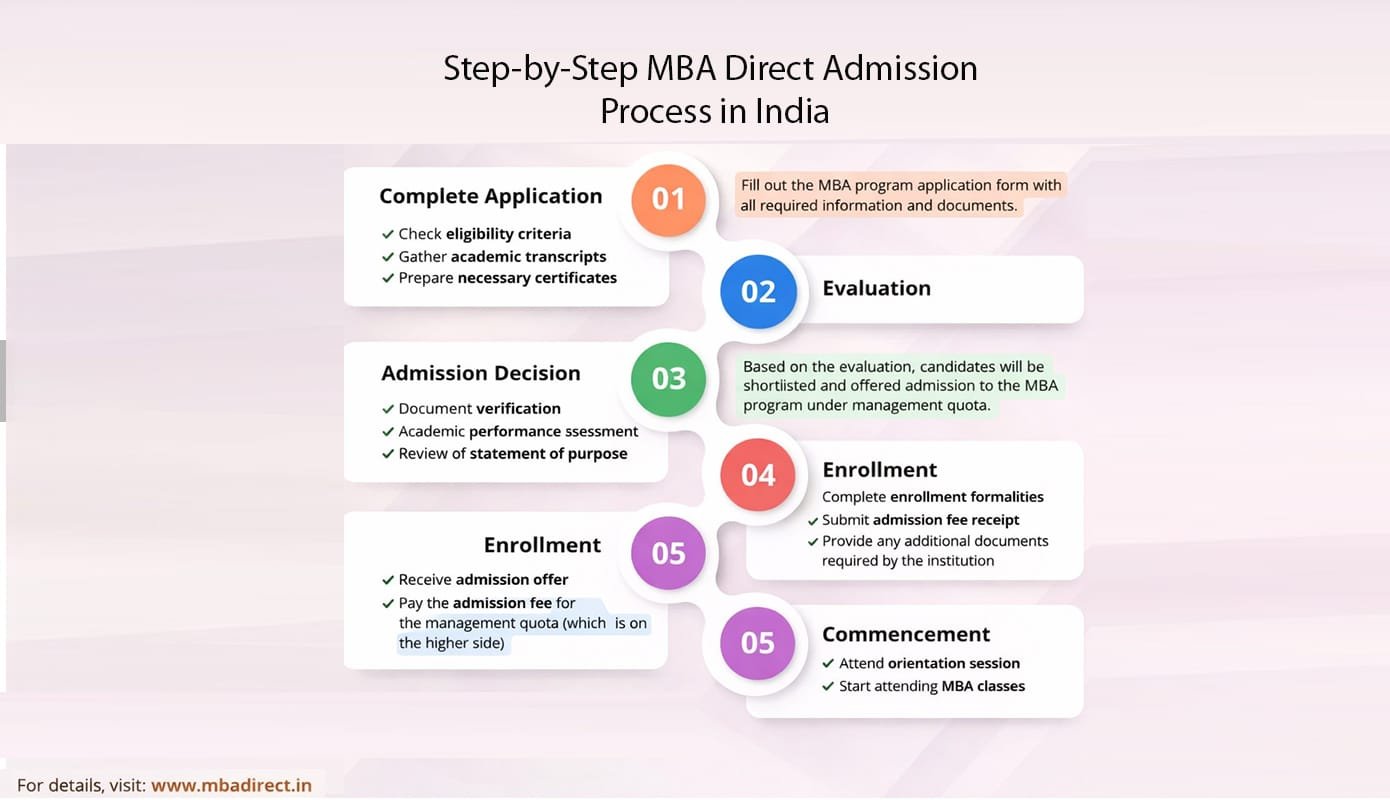
Below is a structured, step-by-step look at how the MBA direct admission process works and what you should prepare at each stage.
1. Understand Eligibility & Defining Direct Admission
Before applying, you should confirm that the colleges you’re targeting actually offer direct admission or management quota seats. Many private MBA institutes in India provide this option, often with slightly different criteria than entrance-based admissions. Typical requirements include:
- A recognised bachelor’s degree (usually minimum 50% aggregate).
- Some colleges may consider work experience as an advantage.
- Personal Interview (PI) or Group Discussion (GD) rounds may still be part of the evaluation.
Note: Premier institutes such as IIMs, FMS, XLRI, SPJIMR, and top state/Government colleges do not offer direct admission without exams.
2. Shortlist Colleges Offering Direct/Management Quota Seats
Start by identifying suitable MBA colleges that have official direct admission or management quota seats. Consider:
- AICTE/UGC approval and accreditation
- Placement records and alumni outcomes
- Specialisations offered and relevance to your goals
- Location, campus infrastructure, and fees
Shortlist about 8–15 colleges based on these criteria and your budget.
3. Contact College Admission Offices or Verified Channels
Once you have a shortlist:
- Reach out via the college’s official website or admissions office. Avoid unverified agents or ads that promise “guaranteed seats.”
- Official contacts will provide accurate details on the management quota application process, seat availability, fees, and deadlines.
- Some institutes may offer counselling sessions online or in person to clarify your options.
4. Complete & Submit the Direct Admission Application
Each college will have its direct admission form, which you’ll need to complete either online or through an offline process. This typically involves:
- Filling in personal and academic details
- Uploading or submitting scanned copies of key documents (10th, 12th, graduation certificates, ID proof, etc.)
- Paying any application or processing fee required by the institute
It’s important to follow the official college portal or admissions office instructions here to avoid errors or delays.
5. Attend Interaction Rounds (If Required)
While direct admission doesn’t require a national/state-level exam score, many colleges still conduct one or more of the following:
- Personal Interview (PI)
- Group Discussion (GD)
- Written Ability Test (WAT)
These rounds are used to assess your communication skills, personality, motivation, and overall suitability for the MBA programme. Some institutions may waive one or more of these components depending on policy and candidate profile.
6. Receive Provisional Offer/Selection Letter
Once your application and any interaction rounds are evaluated, the college will issue a provisional admission or offer letter if you’re selected under the direct or management quota.
This letter typically includes:
- Confirmation of the MBA programme offered
- Fee structure and payment schedule
- Next steps for confirming the seat
7. Fee Payment & Seat Confirmation
To secure your seat:
- Pay the initial admission fees or required deposit before the deadline indicated in the offer letter.
- Colleges often require this payment within a fixed period after the offer is issued.
- Always make payments through official college banking channels to avoid fraud.
8. Documentation & Enrollment Completion
After fee payment:
- Attach and submit original documents for verification.
- Colleges will verify your certificates, identity proofs, and application paperwork before finalising your registration.
- Once verified, you’ll receive an official enrollment letter and details about the academic calendar, orientation, and class start dates.
9. Start Your MBA Journey
Once all administrative procedures are completed and your seat is confirmed:
- Attend orientation sessions
- Complete registration for coursework, library, and ID access
- Begin classes as per the academic schedule
This marks the formal start of your MBA education under the direct/management quota admission route.
Tips for a Smooth Direct Admission Experience
- Start early: Management quota seats are limited and can be filled quickly.
- Verify eligibility: Always check the college’s prospectus and official site for current criteria.
- Avoid unverified agents: Do not rely on unconfirmed promises of seats; only work with official offices.
- Prepare for interviews: Even without an exam score, strong communication and clarity on goals help in PI/GD rounds.